
In Medical Micromolding, the Mold Itself is Key to Success
Medical devices continue to become smaller, more sophisticated and less invasive. Today’s catheters, implantable devices and drug delivery products pack more functionality into increasingly compact designs.
For manufacturers, however, miniaturization creates an entirely new set of challenges. As parts shrink, tolerances tighten. Material behavior becomes more difficult to control. Tiny process variations can have a huge impact on part quality and performance.
It is easy to assume that producing these miniature components simply requires a more precise injection molding machine. In reality, the hidden driver of successful medical micromolding is something far less visible: the mold itself.
What Makes Micromolding Different?
Micromolding is far more than conventional injection molding on a smaller scale.
While there is no universal definition of a “micro” component, these parts are typically measured in fractions of a gram and contain microscopic features requiring tolerances measured in microns.
Micromolded components are found throughout today’s medical devices, including:
- Catheter and cardiovascular components
- Drug delivery devices
- Ophthalmic products
- Hearing devices
- Minimally invasive surgical instruments
Why the Mold Matters
At the micro scale, challenges that might be manageable in conventional molding become significantly more difficult. Resin flow, shrinkage, thermal expansion and even microscopic variations in tooling can influence whether a part consistently meets specification.
The precision of an injection molded part is engineered into the mold long before the first production cycle begins.
Designing a mold for a complex medical component requires engineers to consider dozens of interacting variables. Material selection, gate location, runners, venting, cooling, parting lines, ejection methods and expected shrinkage must all work together to produce a component that fills consistently, ejects reliably and maintains dimensional accuracy over millions of cycles.
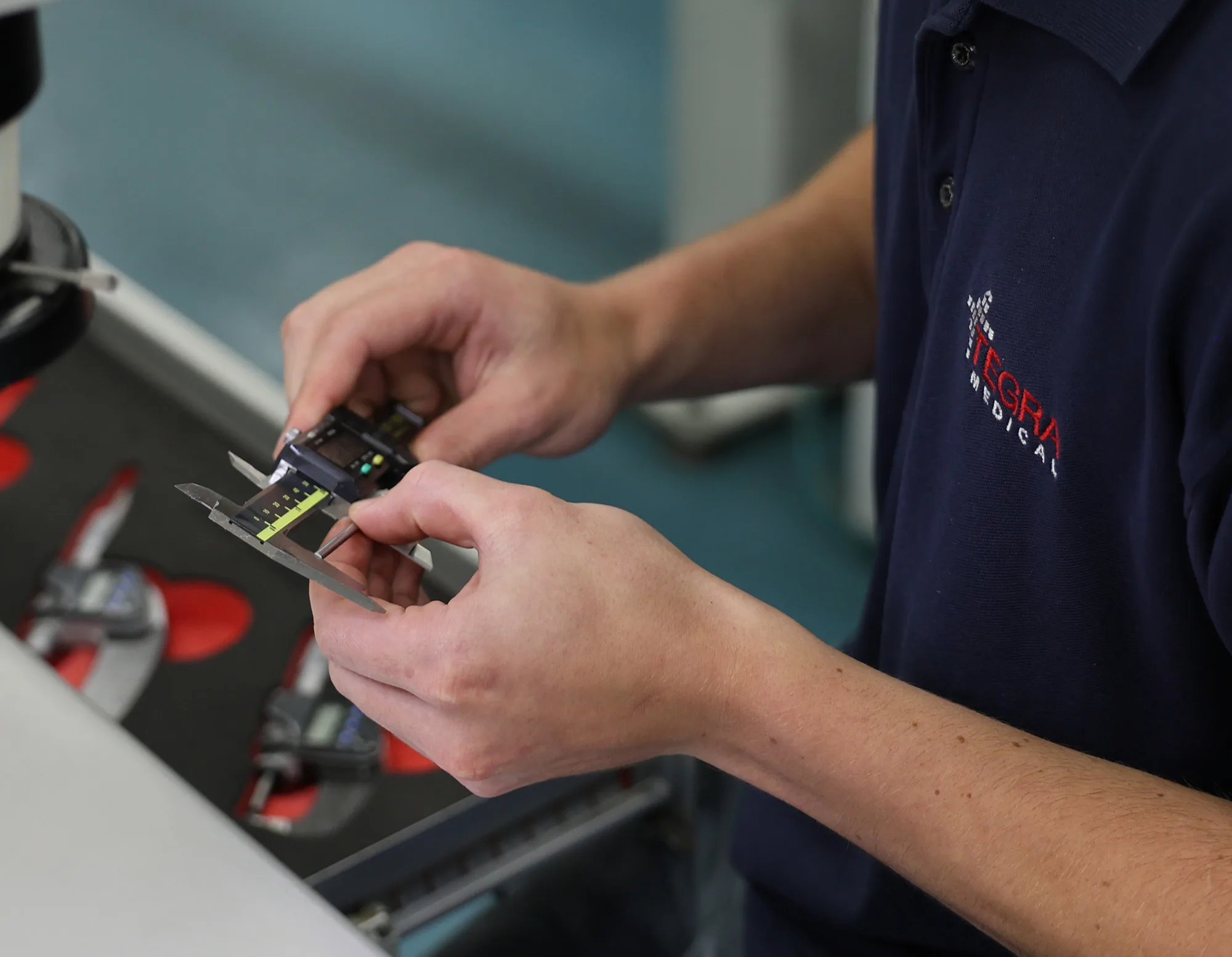
For micro components, the challenge becomes even greater. Complex molds may contain hundreds of precision-machined components, many measured under magnification and manufactured to incredibly tight tolerances. Decisions made before the first piece of steel is machined can determine product quality, manufacturing efficiency and production costs for years to come.
This is why experienced moldmakers insist on early Design for Manufacturability (DFM). By collaborating with OEMs before product designs are finalized, they can optimize geometries, identify manufacturing risks and eliminate costly changes later in development.
Simply put, exceptional molded parts begin with exceptional molds.
The Hidden Advantage: Eight Decades of Moldmaking Expertise
Understanding the importance of tooling helps explain what differentiates Tegra Medical in the micromolding market.
With Stamm’s rebranding as Tegra Medical in 2025, decades of specialized moldmaking expertise became part of the Tegra Medical brand. Built over 79 years of designing and manufacturing highly complex molds for injection-molded products, this deep tooling knowledge strengthens Tegra Medical’s micromolding capabilities and provides customers with expertise that extends far beyond molding capacity alone.
Rather than viewing moldmaking as a separate service, Tegra Medical treats it as the foundation of successful micromolding.
As Rolf Locher, General Manager of Tegra Medical Hallau, explains:
“Success in micro injection molding begins with tooling. What differentiates Tegra Medical is the combination of product and tool engineering, deep expertise in raw materials, and a dedicated focus on small and micro-sized components. Our tooling and molding processes are purpose-built for this level of precision, and they’re backed by 77 years of experience.”
That philosophy extends beyond engineering expertise. It shapes how every project is approached, from early customer collaboration through long-term production.
Why In-house Moldmaking Matters
Many molding companies outsource tooling to independent mold builders. While this approach can work for less demanding applications, it often introduces unnecessary complexity for highly engineered medical devices.
By designing and building molds in-house, Tegra Medical brings product engineering, moldmaking, production and quality teams together from the earliest stages of development. This collaborative approach allows potential issues to be identified before steel is cut and enables rapid adjustments throughout production.
For OEMs, the benefits are significant:
- Faster engineering revisions and design optimization
- Streamlined quality control throughout development and production
- Greater protection of intellectual property
- One accountable manufacturing partner instead of multiple suppliers
- Faster troubleshooting and problem resolution
- Lower total project costs by avoiding supplier markups and production delays
Perhaps most importantly, every discipline contributes its expertise before manufacturing begins. Toolmakers understand how the mold will be built. Production engineers understand how it will run. Quality specialists understand how it will be measured and validated. Together, they help ensure that quality is engineered into the process from the very beginning.
Engineering Precision for the Life of the Product
At Tegra Medical, the mold is not viewed simply as tooling—it is an investment in the entire lifecycle of a medical device.
A well-designed mold can produce millions of high-quality components over many years of production. Achieving that level of performance requires more than advanced machining technologies. It requires decades of accumulated knowledge about materials, mold design, process control and precision manufacturing.
As medical devices continue to become smaller and more sophisticated, that expertise becomes increasingly valuable.
In the world of medical micromolding, the smallest components often demand the greatest engineering expertise. And while the finished mold is rarely seen by the end user, it influences every component that follows.
Contact us to discover the moldmaking advantage for your next medical micromolding project.